

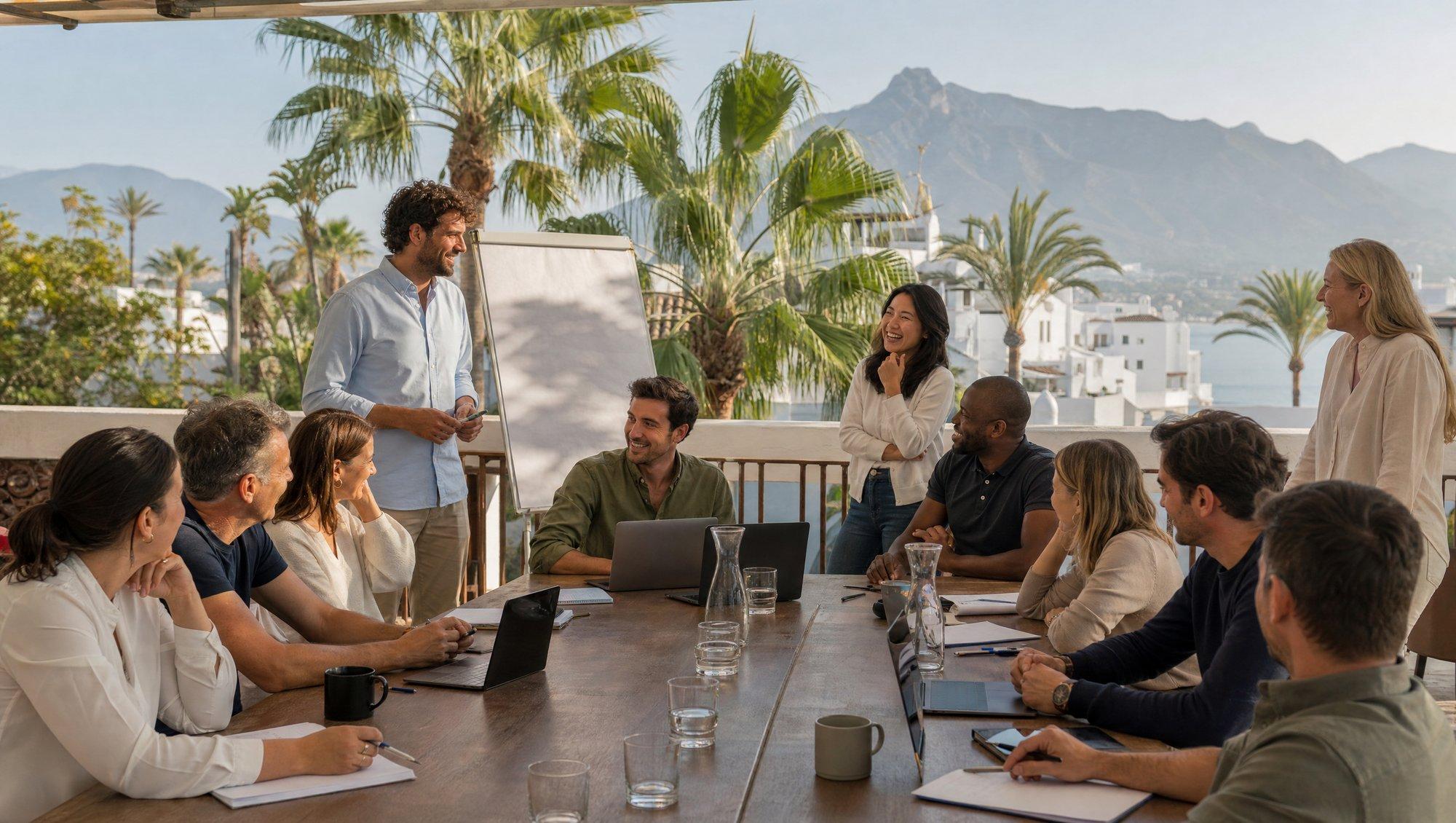
Planning a Corporate Offsite in Marbella: A Guide for International Teams
Marbella sells itself to a leadership team in about four seconds: sun in February, a beach, mountains, direct flights from almost everywhere in Europe. The person who has to actually organise the offsite sees something else — a resort town, not a convention city, where dinner starts at nine, half the coast is a 25-minute drive from the other half, and every supplier quotes “plus IVA”.
This guide is for that person. It covers the decisions in the order you'll have to make them: when to come, how to get twenty or forty people from Málaga airport to the same place, hotel or villa, how to build a programme around the Spanish day rather than against it, and the paperwork that catches foreign companies out. Most of what you'll find online about offsites in Marbella is written by agencies selling packages. This isn't.
Is Marbella the Right Place for Your Offsite?
For most European teams of 10 to 60 people, yes. The case is simple: Málaga airport is one of the best-connected in Spain, with more than a hundred direct destinations even in winter; English is spoken everywhere a visiting team will go; and the climate gives you outdoor afternoons in months when the rest of Europe is grey. The coast also packs very different settings into a short distance — beach hotels, the old town, golf resorts, and mountain villages like Ojén fifteen minutes inland.
It's less obvious in two cases. Above roughly 150 people, your options narrow to a handful of large hotels, and Málaga city (with its conference centre) starts to make more sense. And if the team associates “Marbella” with Puerto Banús nightlife, expect a few raised eyebrows from finance. That reputation is a fraction of the town; the programme you build will decide which Marbella your team sees.
When to Go: The Season Decides Your Budget
April–June and mid-September to October are the sweet spot: warm enough to work outside, sea still swimmable in autumn, hotels at shoulder rates and availability you can actually plan around. These are also the busiest months for company groups, so book venues and the big dinner three to six months ahead.
July and August are peak season. Prices climb, Puerto Banús traffic is slow, and the afternoon heat makes anything outdoors between 1pm and 6pm hard work. If summer is your only window, put the outdoor activity in the morning or after 6pm and keep the middle of the day indoors.
November to March is the underrated option. Days are often 17–20°C and sunny, hotels drop their rates (several publish dedicated winter meeting packages), and you'll have restaurants to yourselves. The trade-offs: the sun sets around 6pm in December, and this is the rainy season — November is usually the wettest month. Plan every outdoor element with a covered fallback and check the AEMET forecast for Marbella (the Spanish met office) a week out. If it does pour, the rainy day guide has indoor options.
One date to avoid unless you mean it: Semana Santa (Easter week, which ends on 28 March in 2027). Processions close streets in the old town, hotels fill with Spanish families, and many local suppliers are booked or closed.
Getting Everyone There: Flights and Transfers
Almost every team flies into Málaga-Costa del Sol airport (AGP), about 50 km from Marbella — forty to fifty minutes by road, closer to an hour to Puerto Banús or on a Friday evening in summer. Teams coming from Madrid can take the high-speed train to Málaga María Zambrano station instead and pick up the same transfer there.
The rule for groups is: one coach, one meeting point, one time. A private coach booked in advance, with a host in arrivals holding a sign, beats twenty colleagues negotiating taxis after a delayed flight. When arrivals are spread across the day, book two or three coach runs and tell people which one they're on. For individual late arrivals, a pre-booked transfer with flight tracking is safer than the taxi rank; the getting around Marbella guide covers taxis, apps and private drivers in detail.
Once you're there, keep the coach (or a couple of minivans) for every group movement. Marbella has no metro, ride-hailing for thirty people at midnight is a lottery, and nobody on an offsite should be driving after dinner.
Where to Stay: Hotel or Villa?
This is the decision that shapes everything else. A hotel gives you meeting rooms, AV, breakfast for everyone, a single bill and staff who handle the unexpected. A villa gives you privacy, a shared kitchen table and the feeling of a team house rather than a business trip — but only up to about fifteen bedrooms, and you become the hotel manager.
Hotels That Handle Company Groups
Hard Rock Hotel Marbella
The Big-Group Option
With 383 rooms and eight modular meeting rooms (the largest configuration takes up to 550 people), this is one of the few properties on this stretch of coast that can sleep, feed and seat a whole department under one roof. It's a resort with a music theme, so the atmosphere is upbeat rather than corporate, which most teams enjoy after a day of sessions.
Insider tip
The hotel publishes separate winter meeting packages for November to March. If your dates are flexible, ask the events team for the current low-season offer before you compare quotes.
El Fuerte Marbella
Beachfront, Next to the Old Town
A Marbella landmark right on the promenade, a few minutes' walk from the old town. It has three meeting rooms, the largest seating around 138 people theatre-style, plus smaller rooms for breakouts. The real advantage is location: your team can walk to dinner, to the beach and to the old town without a single transfer.
Insider tip
Book your free evening around the location: a self-guided tapas crawl through the old town starts five minutes from the lobby.
For leadership retreats where golf or a spa matters, the resort hotels in the hills west of Marbella — Anantara Villa Padierna Palace in Benahavís is the best known — trade walkability for seclusion. Lovely for twelve directors, less practical for forty people who want to go out in the evening.
Your old town evening, by the way, is covered stop by stop in the Old Town tapas guide.
The Villa Option, and Its Two Catches
Large villas sleeping 20 to 30 are common around Marbella and can work beautifully for a small team. Two things decide whether it works for an offsite.
The contract. Many holiday rental contracts ban events or cap the number of non-resident guests. An offsite with an external facilitator, a catered dinner and evening drinks can fall inside those clauses. Ask the owner in writing before you sign; the guide to planning a private event at a rented villa lists what to check, including Spanish noise rules.
The workspace. A dining table and patchy Wi-Fi are not a meeting room. Test the connection with a video call before booking, or plan your working sessions elsewhere: coworking spaces like Spaces on Avenida Ricardo Soriano or The Pool rent meeting rooms by the hour or the day, and most hotels will rent one without rooms attached.
Build the Programme Around the Spanish Clock
The single biggest mistake international teams make is importing their home timetable. In Andalusia, lunch is between 2pm and 4pm and is the main meal of the day; dinner starts at 9pm, rarely earlier. Book a table for thirty at 7pm and you'll either eat in an empty room or be told the kitchen isn't open yet. The guide to sobremesa explains the rhythm, and why the long lunch is where the real conversations happen.
Work with it rather than against it. Mornings are for focused sessions. The afternoon is for the shared experience, built around a long lunch. Evenings are late, so give people a break between 6pm and 8.30pm or they'll be flat at dinner. Here's a structure that works for a three-day, two-night offsite:
A Sample 3-Day Programme
Day 1 — Arrive and land softly. Flights in by early afternoon, coach to the hotel, a short welcome session around 5pm. Dinner close to the hotel, no big production: someone's flight will be late, and you want everyone fresh for day two.
Day 2 — Work, then the shared experience. Sessions from 9.30am to 1pm. Then leave the meeting room behind for the afternoon: a team activity that ends in a long lunch, ideally away from the coast. Free evening, or an informal tapas walk for those who want it.
Day 3 — Decide, then celebrate. A morning session to turn the conversations of day two into decisions. Free afternoon (beach, golf, sleep). Farewell dinner at 9pm, with a flamenco show afterwards if the group has the energy — the Marbella at night guide has the rest of the evening options.
Day 4 — Departures. Check-out is usually noon; schedule the coaches to leave the hotel about three hours before the first group's flight.
Two rules keep the programme humane. First, one big thing per day: an activity and a gala dinner and a night out on the same day is how offsites end with half the team skipping breakfast. Second, choose activities everyone can do. The honest comparison of team building activities on the Costa del Sol scores karting, regattas, canyoning and city games on exactly that.
The Group Dinner: Book It First
Thirty people at 9pm on a Friday in May is the hardest booking of the whole trip, so make it before anything else. Restaurants that take groups will usually ask for a menú de grupo (a fixed set menu chosen in advance), a final headcount 48 to 72 hours before and a deposit. Send dietary requirements with the headcount, not on the night — vegetarian, gluten-free and no-alcohol guests are easy to plan for and hard to improvise.
If the team is staying in a villa, consider bringing dinner to the house instead: no transfers, no closing time, and the conversation doesn't stop when the bill comes. The group dinner guide compares self-catering, restaurants and a chef on site for 15 to 50 people, and the catering cost guide explains what a fair price per person looks like.
Paperwork: Invoices, VAT and Who Does What
Ask for a factura, not a receipt. To recover costs properly, your company needs an invoice in its name with its tax number (NIF, or EU VAT number). Spanish suppliers can only issue one if you give them those details, ideally when you confirm the booking. A till receipt (ticket) at the end of a dinner is not an invoice.
Check whether prices include VAT. Spanish VAT is called IVA, and corporate quotes are often given “+ IVA” (before tax). When you compare two suppliers, make sure you compare like with like.
Read the cancellation terms. Deposits are standard for anything involving food or exclusive venues, and so are cut-off dates for reducing numbers. Know them before the headcount starts moving.
Agency or DIY? A destination management company (DMC) earns its fee above about forty people, when there are several venues and transfers to coordinate, or when nobody in-house speaks Spanish. The Costa del Sol tourism board runs a convention bureau that can point you to member agencies. Below twenty-five people, a capable office manager with a handful of good direct suppliers will usually get a more personal trip for less.
The Afternoon Your Team Talks About on the Flight Home
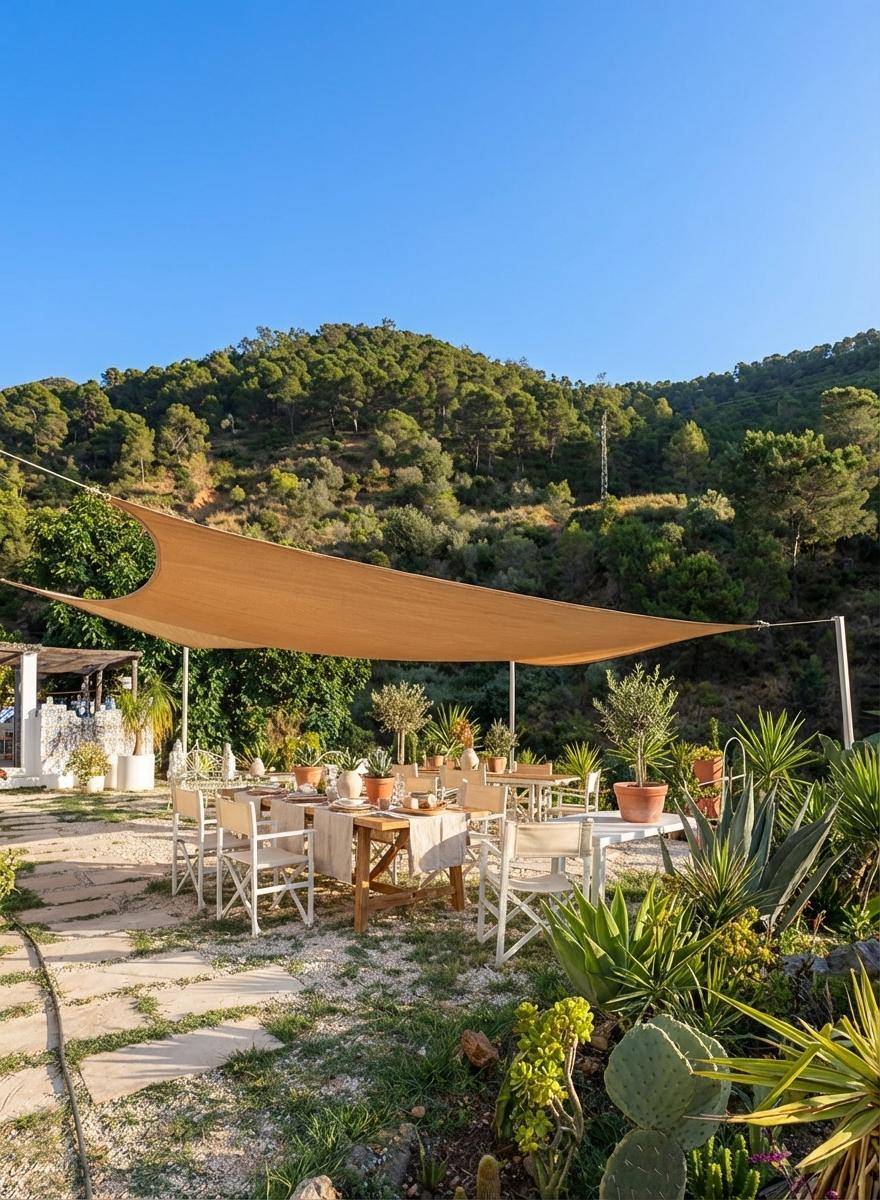
Back to day two, and that afternoon away from the meeting room. Fifteen minutes up the hill from Marbella, past the village of Ojén, there's a private finca where Chef Paco Siles — a third-generation Maestro Arrocero whose family has been cooking rice since 1972 — hosts company teams around a real paella fire. One group at a time, olive trees and the Sierra de las Nieves behind, long tables under a sail shade. It ticks every box above: everyone can take part, it runs on the Spanish clock (it is the long lunch), and it's hosted in English, Spanish or French.
There are two formats. In the Experience, the team settles in with drinks and tapas and watches Paco cook a traditional paella from scratch before sitting down to eat it — good for client entertainment and mixed teams (4 to 30 people, about four hours, from €55 per person excl. VAT). In the Challenge, teams of five or six get their own cooking station after a sangria workshop and compete to make the best paella, with Paco coaching and judging (8 to 30 people, about four and a half to five hours, from €65 per person excl. VAT). Drinks, tapas, the meal and fresh fruit are included. Groups meet in Ojén village; transport from your hotel isn't included but can be quoted with the rest.
If the schedule can't fit a trip to the hills, the cooking comes to you instead: paella or brasero BBQ cooked live at your villa or venue for 8 to 30 guests (paella from €45 per person), or a full crew with several stations for 30 to 100+. Every format is quoted in writing and invoiced to your company.
Quick Reference — Corporate Offsite in Marbella
| Decision | The short answer |
|---|---|
| When | April–June, mid-Sept–Oct; Nov–March for value |
| Getting there | Fly to Málaga (AGP), private coach, 40–60 min |
| Big group hotel | Hard Rock Hotel Marbella (up to 550) |
| Walkable hotel | El Fuerte Marbella (beach + old town) |
| Villa | Up to ~30 people, great for small teams |
| Timing | Lunch 2–4pm, dinner from 9pm |
| Paperwork | Factura with company name + tax number |
| Team afternoon | Paella team building at a finca in Ojén, 4–30 people |