
Team Building on the Costa del Sol: Why Cooking Together Beats Karting
Ask an office manager to organise a team day on the Costa del Sol and the first search result will say karting. It's fast to book, easy to explain, and nobody gets fired for choosing it. Then the day comes: eight minutes on the track, a helmet that makes conversation impossible, the same three competitive colleagues on the podium, and everyone else standing behind a fence with a coffee.
Karting isn't a bad activity. It's just a bad team building activity, because it measures who drives fastest, not who works well together. This guide is an honest comparison of the formats that actually exist between Marbella and Málaga — karting, sailing regattas, canyoning, city games and cooking — with real prices where they're published, the catches nobody mentions in the brochure, and a simple test to pick the right one for your team.
What a Team Building Activity Actually Has to Do
Before comparing options, it helps to be clear about the job. A company day out on the coast is usually trying to do four things at once, and most activities only manage one or two of them.
1. Include everyone. Your team has a colleague with a bad knee, one who's pregnant, one who doesn't drink, one who gets seasick and one who is terrified of heights. An activity that excludes any of them is an activity where they spend the day holding the bags.
2. Create conversation. The value of a team day is the talking that doesn't happen in the office — the finance director chatting to the new junior developer, the two departments who only know each other by email. If the activity is loud, fast or done in helmets, that conversation happens later, in the bar, if at all.
3. Flatten the hierarchy. The best moments come when the CEO is no better at the task than the intern. Activities where seniority or fitness predicts the result don't do that.
4. End around a table. Every good company day on the Costa del Sol ends with a long lunch. The question is whether lunch is an add-on, organised separately with a second supplier and a second bus, or whether the activity is the lunch.
Keep those four tests in mind. Here's how the usual options score.
Karting: Great Adrenaline, Poor Team Building
There are two serious karting circuits within half an hour of Marbella, and both are well run. Karting is the right call when your team is young, competitive and needs to blow off steam after a long conference. It's the wrong call when the goal is to get people talking.
Funny Hill
Karting With Sea and Mountain Views
The successor to the old Funny Beach (the Marbella karting institution since 1992), Funny Hill sits on the old road up to Ojén with views over the coast. The track is short and technical rather than fast, which keeps it fun for beginners. Adult karts, two-seaters and kids' karts run side by side, and the park offers exclusive track hire for company groups who want a proper race between colleagues.
Insider tip
It's on the old road up to Ojén, so it pairs naturally with an afternoon in the hills. Published opening hours are 3–9pm on weekdays and from noon at weekends, so ask them directly about an exclusive morning slot for a group.
Further east, Karting Mijas opened in 2024 near the A-7 between Fuengirola and Mijas, with a 900-metre circuit and adult karts that reach around 80 km/h (from €25 per session, special group prices on request via kartingexperience.com). It's the better pick if your hotel is on the Fuengirola or Benalmádena side.
The honest verdict: karting scores well on fun and badly on everything else. It's individual, not collaborative; it rewards the people who already have confidence; and it's physically off-limits for anyone pregnant or with a back problem. If your team insists, use it as a warm-up, never as the main event — and always drive before the wine, not after.
Sailing Regattas: Real Teamwork, Real Weather Risk
A regatta is the opposite of karting: nobody can sail a boat alone, so the activity forces people to coordinate, communicate and trust each other. It's probably the most “genuine” team building format on the coast.
The typical format, as run by operators like MedBoat, is a morning briefing, a couple of hours of sail training with a skipper on each boat, lunch, then a race back to port with a prize for the winning crew. Puerto Banús itself has used the format for its own staff: the marina organised a team regatta for its customer service and maritime departments with Try Sail, a sailing school based in the port, running from 10am to 2pm followed by lunch (the marina's write-up).
The catches: the Mediterranean decides. The wind can cancel a sailing day at short notice, seasickness quietly removes one or two colleagues from every group, and pricing is always on request because it depends on the number of boats. Good option for a sporty team in late spring or early autumn — just have a plan B. If you're looking at boats for a smaller celebration rather than a corporate day, the experience gifts guide covers private sunset sails.
Canyoning and Outdoor Adventure: Unforgettable, If Everyone Can Do It
A short drive inland from San Pedro, the Río Guadalmina cuts a narrow gorge below the village of Benahavís, and local guides run canyoning descents through it: wetsuits, helmets, natural slides, jumps into rock pools, a short abseil. Teams come back soaked, laughing and with stories they'll tell for years. The gentler version — the river walk up from Torre Leonera park — is covered in the hidden gems guide, and the wider outdoor options in the nature and outdoor activities guide.
The catches: this is the activity that fails the inclusion test hardest. It needs basic fitness and swimming confidence, it's realistically a warm-season activity (the river water is cold in winter), and guides work in small groups, so a team of thirty becomes three separate outings. Brilliant for a group of ten adventurous colleagues; a logistics headache for a whole department.
City Games and Escape Rooms: Cheap, Easy, a Bit Generic
App-based treasure hunts are the budget-friendly option, and they do get people talking. myCityHunt runs team events through Marbella's old town — murder mystery, treasure hunt, escape game formats — at a published price from £15.99 per person plus VAT, with teams playing on their phones at their own pace for three to four hours.
The old town is a lovely backdrop, and if you choose this format, finish the afternoon properly with a crawl through the bars covered in the Old Town tapas guide. The catch: half the team ends up staring at a screen, which is exactly what they do all week. It works as an icebreaker on the first afternoon of an offsite, less well as the highlight.
Why Cooking Together Wins
Run the four tests on a cooking day and the difference is obvious.
Everyone can take part. There's a role for every level of energy and confidence: someone chops, someone measures the stock, someone keeps the fire honest, someone takes the photos and someone tastes. The colleague with the bad knee pulls up a chair. The one who doesn't drink runs the sangria station for everyone else. Nobody is sidelined.
It creates conversation by design. A paella takes the best part of an hour from sofrito to socarrat, and most of that hour is waiting, watching and arguing about whether it's ready. That's exactly the kind of slow, shared time that turns colleagues into people who know each other.
It flattens the hierarchy. The managing director has no head start on a paella. In a team format, the best rice often comes from the group with the quietest, most patient person stirring — and everyone notices.
It ends at the table, automatically. No second supplier, no transfer to a restaurant. The activity becomes the long Spanish lunch, with local wine (see the Málaga wines guide for what to pour) and a sobremesa that runs as long as you let it.
“I've watched hundreds of groups cook paella. The pattern is always the same: for the first twenty minutes they behave like they're at work — the boss gives orders. Then the rice goes in, nobody really knows what they're doing, and suddenly they're a team. By the time they taste each other's paellas, they're laughing about it. That's the moment you can't buy at a go-kart track.”
— Chef Paco Siles
Combining Formats: The Best of Both
Some teams want the adrenaline and the table, and on this coast the geography makes that easy. The old Ojén road climbs out of Marbella past the karting track and into the hills; the village of Ojén is about ten minutes further. A short race in the late morning, then up to the mountains for a slow afternoon of cooking and eating, works far better than the other way round — nobody should be driving a kart after lunch.
The same logic works with a regatta day (sailing in the morning, cooking the next day) or a city game on the first afternoon of a multi-day offsite. If you're planning several days with mixed groups, the group activities guide has more ideas.
A Paella Team Day in the Hills Above Marbella
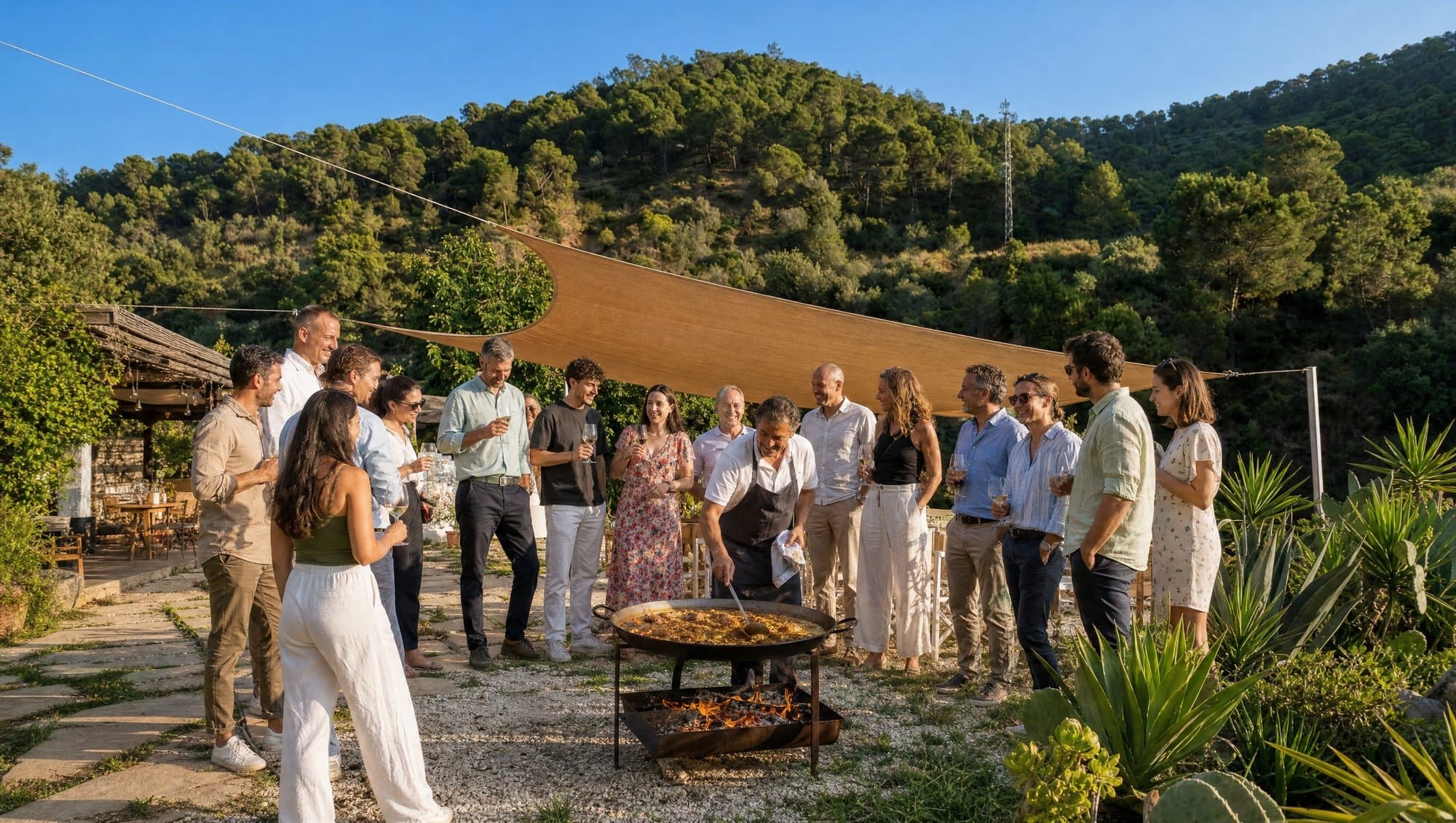
Up in those hills, past the village of Ojén, there's a private finca where Chef Paco Siles — a third-generation Maestro Arrocero whose family has been cooking rice since 1972 — hosts company teams around a real paella fire. The finca is reserved for one group at a time: olive trees, agaves, a terrace under a sail shade, and the Sierra de las Nieves behind.
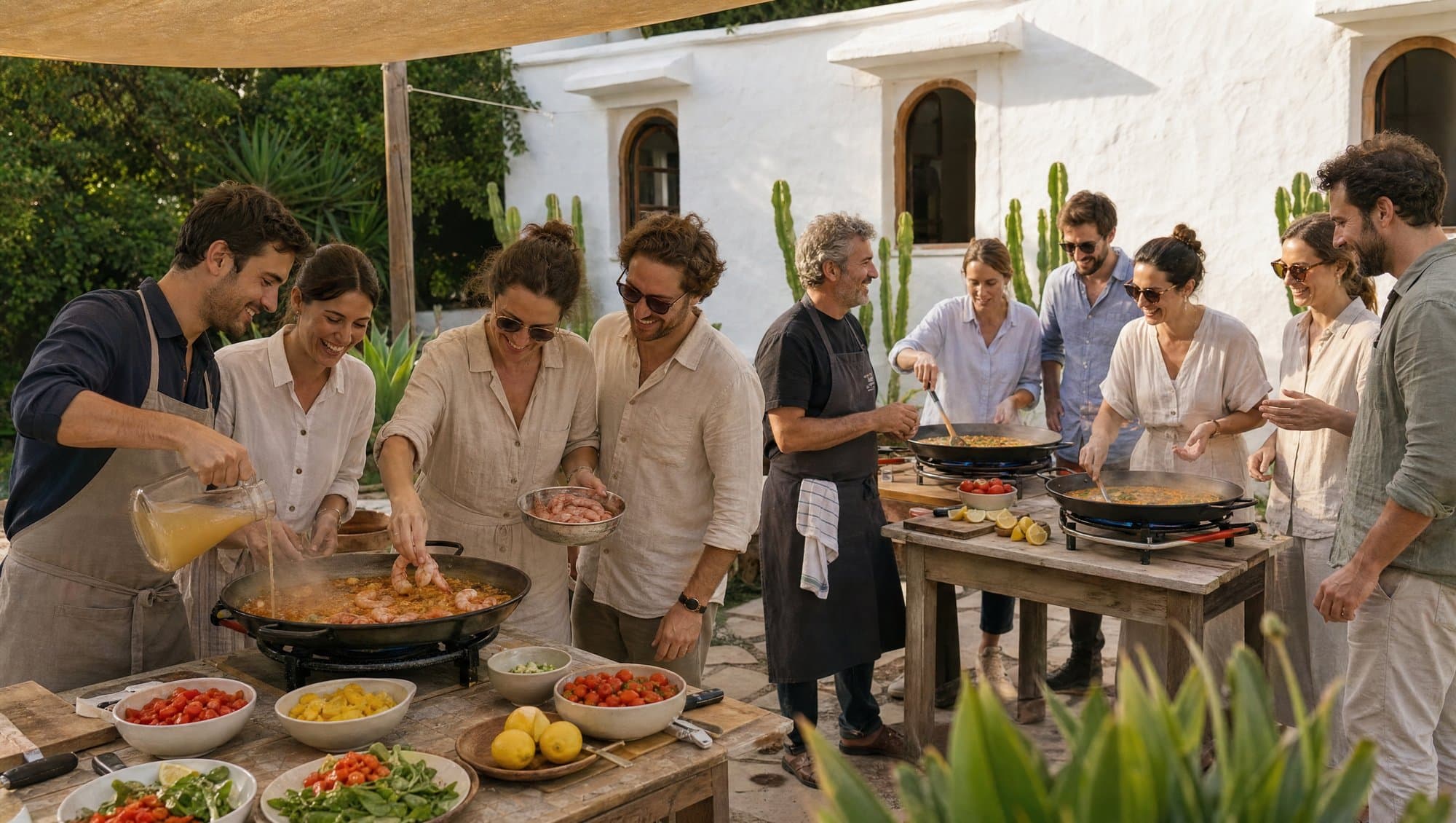
There are two formats, and the choice follows the four tests above. The Experience is the relaxed one: welcome drink and tapas, wine, beer and soft drinks throughout, and the team watches Paco cook a traditional paella from scratch before sitting down to eat it. It suits client entertainment, mixed-age teams and anyone who wants to talk more than cook (4 to 30 people, about four hours, from €55 per person excl. tax). The Challenge is the hands-on one: a sangria workshop to start, then teams of five or six at their own cooking station, each building a paella with Paco coaching and judging, and a final tasting of every pan (8 to 30 people, about four and a half to five hours, from €65 per person excl. tax).
Groups meet in Ojén village and drive up together; transport isn't included but can be quoted on request. Sessions run in English, Spanish or French, and the price is per person on a sliding scale — the bigger the team, the lower the rate.
Quick Reference — Team Building on the Costa del Sol
| Activity | Includes everyone? | Price |
|---|---|---|
| Karting (Funny Hill, Karting Mijas) | Partly — not for pregnancy, back issues | From €25 per 8-min session |
| Sailing regatta (Puerto Banús) | Mostly — seasickness, weather | On request |
| Canyoning (Río Guadalmina) | No — fitness and swimming needed | Via local guides |
| City game (Marbella Old Town) | Yes | From £15.99 pp + VAT |
| Paella team building (finca, Ojén) | Yes — a role for everyone | From €55 pp excl. tax |