

Villa Survival Guide: Your First 24 Hours in a Marbella Holiday Rental
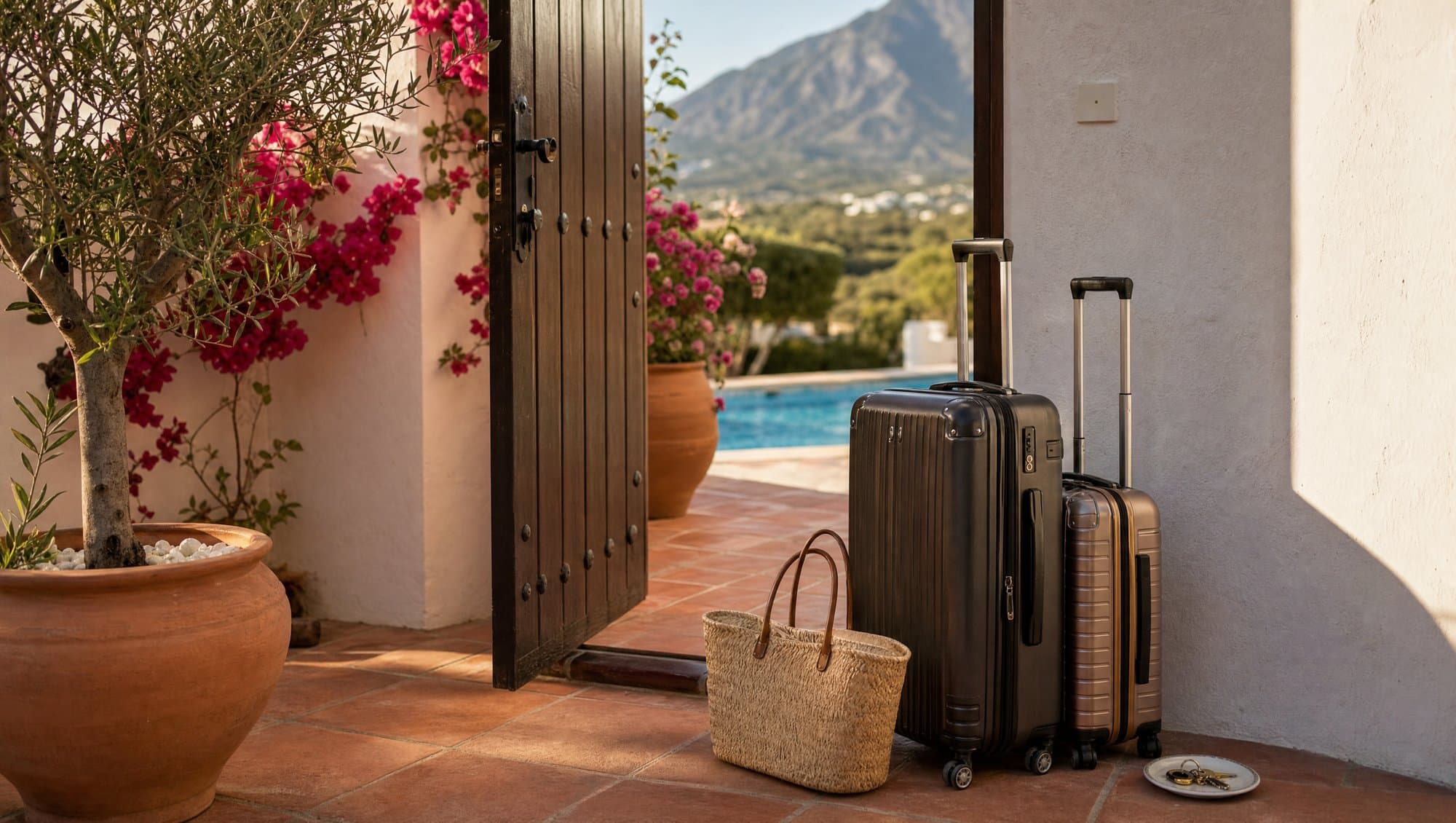
The photos showed an infinity pool, a terrace and a view of the sea. What they didn't show was the arrival: a key box nobody can open in the dark, an oven that trips the electricity the moment the air conditioning kicks in, a fridge containing half a lemon, and eight hungry people asking where dinner is on a Sunday evening.
Renting a villa on the Costa del Sol is the best way to do Marbella — space, privacy, a pool of your own. But the first twenty-four hours decide the tone of the whole week. This guide walks through them in order: what to sort out before you land, what to check before you unpack, how to survive the first shop, and how to deal with the first dinner without anyone having to cook.
Before You Land: Five Things to Settle With Your Host
Most arrival-day problems are solved by a single message to the host or the agency three or four days before you fly. Ask these five questions, in writing, so the answers are on your phone when you need them.
- How exactly do we get in? Key box, gate code, someone waiting for you? And what happens if your flight lands at 23:00? Many villas sit inside gated urbanizaciones with a security barrier — ask whether the guard has your name.
- The address and the pin. Get the full Spanish postal address and a Google Maps pin. Urbanisation streets in the hills above Marbella often confuse sat-navs, and taxi drivers will ask you for the pin, not the villa's name.
- Guest registration. Since December 2024, Spanish law (Real Decreto 933/2021) requires holiday-rental hosts to register every guest with the authorities. Expect to send passport or ID details for everyone aged 14 and over, usually through an online check-in link. It's legitimate — send it through the official booking platform or the agency, never by an unknown link.
- Who comes, and when. Pool cleaner, gardener, housekeeping: most villas have scheduled visits. Knowing the pool man comes on Tuesdays at 9:00 saves an awkward moment at breakfast.
- The rules in the contract. Maximum number of guests, parties, noise, visitors. If you're planning a celebration during the stay, read the guide to hosting a private event in a Marbella villa before you promise anyone a party.
On transport: Málaga airport is about 50 km from Marbella, forty-five minutes to an hour by road. A pre-booked fixed-price transfer is worth it for a group — one minivan instead of two taxis, and nobody standing in the rank with tired children. If your villa is in the hills of Benahavís, Istán or Ojén, you will want a hire car for the week anyway; supermarkets and restaurants are rarely walkable from there.
Hour 0–1: The Walk-Through (Before Anyone Unpacks)
The temptation is to drop the bags and jump in the pool. Give it fifteen minutes first. Everything below is easier to sort out at 17:00 on arrival day than at 22:00 — or on day three, when the host is harder to reach.
Photograph Everything
A quick video of every room, the terrace furniture and anything already chipped or stained. It takes three minutes and it's your best friend when the security deposit comes back.
Find the Fuse Box
Spanish homes have a contracted power limit, the potencia contratada. If the villa's is on the low side, running the oven, the dishwasher and two air-conditioning units at once will trip the main switch. Find the fuse box (often in the entrance or the kitchen), learn which switch is the general one, and you'll be the hero of the first evening when the lights go out. The rule of thumb: don't run all the big appliances at the same time.
Hot Water and Gas
Many older villas run the hob — and sometimes the water heater — on butane: an orange bottle (Repsol) or a silver one (Cepsa), usually in a kitchen cupboard or a small outdoor cabinet. Ask where the spare is. Bottles must always stand upright, and when the hob flame starts to weaken, it's time to swap. If there's an electric water heater instead, it may be switched off between rentals — turn it on as soon as you arrive, or the first showers will be cold.
The Pool
Check the depth markings, the steps and whether there's a fence or a cover — non-negotiable if you're travelling with small children. Find out whether the pool is heated (often an extra cost outside summer, and it needs a day or two to warm up, so ask before you arrive). And keep the chemicals cupboard closed.
Water and Bins
Tap water in Marbella is safe to drink. Many locals still buy bottled water for the taste, so do as you prefer — but there's no need to haul crates of it up the hill for safety reasons. As for rubbish: in most urbanisations there's no doorstep collection. You take your bags to the communal containers on the street. Yellow for plastic, cans and cartons; blue for paper and cardboard; green bell-shaped bins for glass; grey or green for everything else. Ask the host where the nearest ones are — after a week of villa dinners, you will need them.
Hour 1–3: The First Shop (and the Sunday Trap)
Villa kitchens are usually stocked with salt, a little oil, maybe some coffee capsules. Everything else is on you. Here's what catches people out.
Sundays Are Different
Mercadona, the supermarket every Spaniard shops at, is open Monday to Saturday (roughly 9:00 to 21:30) and closed on Sundays and public holidays for most of the year — a few coastal stores open on Sunday mornings in July and August only. Marbella is classed as a tourist area, so plenty of other shops do open on Sundays, but hours vary branch by branch. If you land on a Saturday afternoon, do the big shop that day. If you land on a Sunday, check opening hours on Google Maps before you drive anywhere, and use the small supermarkets near the coast or a petrol-station shop to bridge the gap until Monday.
Mercadona stores in Marbella on Google Maps
The Arrival Shopping List
Keep it short. You're not stocking for the week, you're surviving until tomorrow:
- Breakfast: coffee, milk, fruit, yoghurt, a loaf of bread, tomatoes and a bottle of good extra virgin olive oil (more on that below).
- Drinks: water, juice for the kids, beer, a couple of bottles of local wine, and ice — villa freezers rarely have ice trays, and bags of ice are sold in supermarkets and petrol stations.
- Household: dishwasher tablets, washing-up liquid, kitchen roll, toilet paper, rubbish bags.
- Survival: high-factor sunscreen, after-sun, and a plug-in mosquito repellent — from late spring to autumn, open bedroom windows invite them in.
Save the fresh produce for the next morning. A Marbella market is a far better place to buy fish, fruit and vegetables than a supermarket, and the guide to Marbella's food markets tells you which day to go where.
“For the first breakfast, you need three things: good bread, ripe tomatoes and good olive oil. Toast the bread, rub it with tomato, pour the oil, a little salt. That is how Andalusia eats in the morning, and it costs nothing. Spend the money on the oil — it's what makes the difference.”
— Chef Paco Siles
Hour 3–6: The First-Night Dinner Problem
This is where most villa holidays wobble. Everyone has been travelling since dawn, half the group is in the pool, and somebody has to decide what eight or ten people are going to eat. The options, honestly assessed:
Cook
In theory, easy. In practice, you're in an unfamiliar kitchen with two frying pans, blunt knives and an oven whose dial nobody understands, after a day of airports. If you're going to cook one night this week, don't make it the first.
Go Out
Spain eats late. Most restaurant kitchens close after lunch around 16:00 and don't reopen for dinner until 20:00 or 20:30, with the busiest tables at 21:30. Finding a table for ten at short notice in high season is hard, someone has to stay sober to drive back up the hill, or you need two taxis each way. On a quieter arrival evening, a tapas crawl through the old town works well for a small group — the old town tapas guide has the route — but for a big group with children, it's rarely the relaxing first night anyone imagined.
Order In
The delivery apps work in central Marbella and along the coast, but coverage thins out quickly once you're up in the hills, and food for ten people arriving in plastic boxes from three different restaurants is nobody's idea of a first Spanish dinner. Which is why villa regulars do something else.
The First-Night Trick Villa Regulars Use
The people who come back to the same villa every year tend to have the first night solved before they even board the plane: they order a proper paella, cooked that day and delivered hot to the villa, and eat it on the terrace while the sun goes down.
Si Catering's Paella Delivery is run by Chef Paco Siles, a third-generation paella cook whose family has been in restaurants since 1972. The paella is cooked from scratch on the day — not reheated, not boxed — and arrives in the traditional paellera, the wide steel pan, ready to put straight on the table. Five recipes: Valenciana with chicken, Vegetarian, Seafood, black rice with cuttlefish ink, and the Royale with lobster, from €18 per person, for groups of six or more and up to two recipes per order. You can add a starter kit (tortilla, aioli, salad and bread, or a tapas board with jamón ibérico and manchego), a jug of homemade sangria or a wine and beer pack. Nobody washes the pan: it gets collected later that evening or the next day.
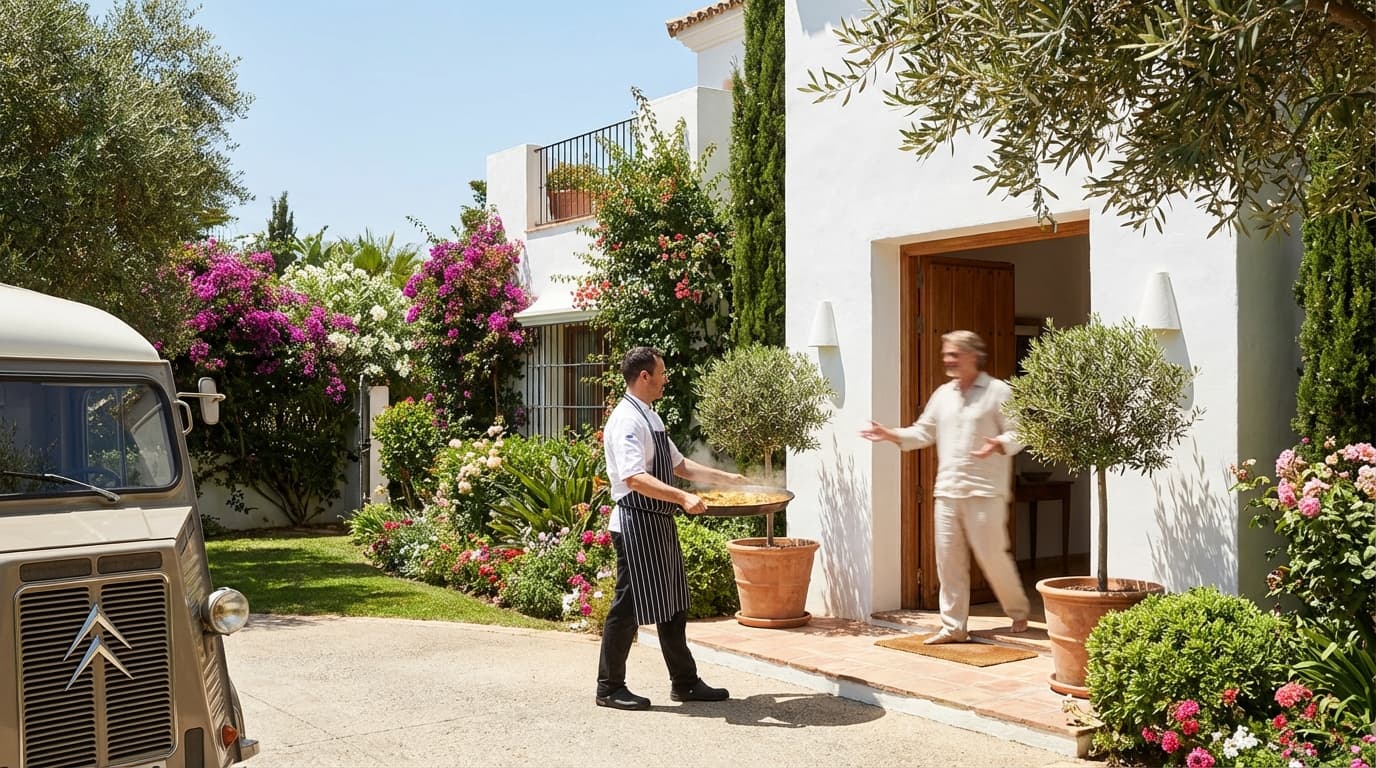
Delivery covers Marbella and around 30 km — Puerto Banús, Nueva Andalucía, San Pedro, Benahavís, Estepona, Mijas, Fuengirola. Same-day orders are possible with four hours' notice, but the smart move for an arrival day is to book before you fly and pick a time an hour or two after you expect to reach the villa. The only thing you need to provide is plates and forks — every villa kitchen has those.
Hour 12–24: The Morning After
Day two is when the holiday actually starts. Three things to get right.
Breakfast Out, or Bread In
Either walk to the nearest panadería before 10:00 for fresh bread and pastries, or treat the group to breakfast out — a tostada and a café con leche at a bar costs a few euros and is the most Spanish thing you'll do all week. The guide to breakfast in Marbella lists the best spots. Then do the proper shop.
Respect the Midday Sun
From June to September, the hours between 13:00 and 17:00 are for shade, the pool and lunch, not for hiking or walking around the old town. Sunburn on day two has ruined more Marbella holidays than any rental problem. Plan outings for the morning or the late afternoon — the family activities guide and the day trips from Marbella are good places to start.
Know Where to Go if Something Goes Wrong
Nobody wants to need it, but it takes two minutes to save in your phone:
- 112 — the single emergency number in Spain (ambulance, police, fire). Operators speak English.
- Pharmacies — look for the green cross. Pharmacists in Spain give real advice for minor problems, and outside normal hours a rota of duty pharmacies (farmacias de guardia) stays open. The current list for Marbella is on the Spanish pharmacists' council website, and every pharmacy posts it on its door.
- Hospital — the public Hospital Universitario Costa del Sol, on the A-7 east of Marbella, runs a 24-hour emergency department.
Hospital Universitario Costa del Sol
The Main Public Hospital on the Coast
The reference hospital for Marbella and the western Costa del Sol, part of the Andalusian public health service. The emergency department (Urgencias) is open around the clock. European visitors should bring their EHIC or GHIC card; everyone else, their travel insurance details. Private hospitals and clinics also operate in Marbella if your insurance prefers them — check your policy before the trip, not after the accident.
Insider tip
The emergency entrance is not the main outpatients entrance — follow the 'Urgencias' signs. For anything serious, call 112 rather than driving: give them the villa's address and Google Maps pin, which is exactly why it's worth having saved.
And one last piece of advice for the morning after: put the villa's address, the host's number and the Wi-Fi password in the group chat. You will be asked for all three at least ten times this week.
Quick Reference — Your First 24 Hours
| When | What | Key tip |
|---|---|---|
| Before you fly | Message the host | Access, address + Maps pin, guest registration, staff visits, house rules |
| Hour 0–1 | Walk-through | Video every room, find the fuse box, check gas, hot water and pool |
| Hour 1–3 | First shop | Mercadona closed on Sundays most of the year — check hours before driving |
| Hour 3–6 | First dinner | Restaurants open for dinner from 20:00–20:30; don't cook on night one |
| Next morning | Breakfast & market | Bread, tomato, olive oil — then the food markets |
| Anytime | Emergencies | 112 · green-cross pharmacies · Hospital Costa del Sol |
| Night one | Paella Delivery | Cooked on the day, delivered hot in the pan · 6+ guests · from €18/pp |